Tampilkan postingan dengan label 1960s. Tampilkan semua postingan

Rabu, 09 Januari 2013

Grant Featherston - Aristoc Scape stool with steps

Grant Featherston designed the scape range of chairs and stools for Aristoc which included this very practical set of steps. I have previously posted about the dining chairs here and the stools here.


Grant Featherston designed Aristoc scape stool with steps.

Decor - Kids Cup

Insulated plastic cups with image inserts were very popular in the 1960s, often in sets of four or six. This kids size is much less common.


Decor insulated kids cup by Brian Davis Plastics.

Selasa, 08 Januari 2013

Be Seated - Mid Century furniture

The Danish Deluxe Inga arm chair was manufactured in Victoria in the 1960s. Danish Deluxe was a major Victorian furniture manufacturer from the 1950s to the 1980s. The company was formed by Neville Askanasy, John Westacott and Borg Gjorstvang.

Be Seated from Portland Victoria specialise in restoring Mid Century modern furniture including; Danish Deluxe, Fler, Featherston, Meadmore, Parker and Tessa.


Danish Deluxe Inga arm chair restored by Be Seated.


Be Seated - Mid Century modern furniture.


Selasa, 04 Desember 2012

Australian Design Icon - Regis Glassware

A world first with production and export totalling more than 170 million units the Regis glassware range truly is an Australian industrial design icon.


Regis glassware range logo - Australian design icon.


Australian design icon the Regis glassware range designed by industrial designer Edward Kayser for Crown ACI.

Minggu, 19 Agustus 2012

Irwell Taps - Design classic

The Design Award winning taps by Paul Schremmer for Irwell are well documented as icons of pioneering Australian industrial design. They feature in the 1967 Australian industrial design promotional video I have referred to previously.

Today I was proudly able to post to my facebook page ispyid an image of the taps still in use taken at the Victorian College of the Arts.


Iconic Australian industrial design by Paul Schremmer for Irwell.


Paul Schremmer original sketches for the iconic australian designed Irwell taps.

Selasa, 26 Juni 2012

Ian Edgar - Kriesler Radio

This early injection moulded Kriesler radio by industrial designer Ian Edgar popped up recently.


Detail with Australian Kriesler Radio branding.


Kriesler Radio logo.


Australian Kriesler radio designed by industrial designer Ian Edgar. 


Sabtu, 18 Februari 2012

Regis Glassware - Edward Kayser

I have written several posts about the iconic and highly awarded 'Regis' range of glassware by RMIT alumnus industrial designer Edward Kayser. I had not seen this page from the Australian Design Index until recently.


Australian Design Index - Iconic Australian Regis Glassware by industrial designer Edward Kayser.


Kamis, 16 Februari 2012

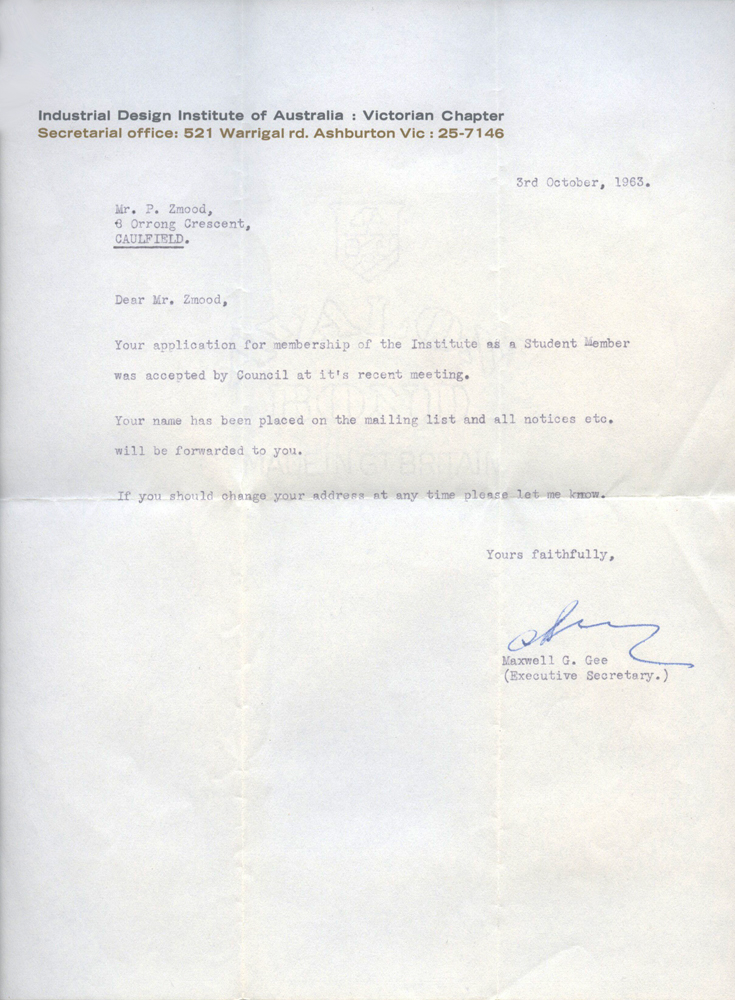
Phillip Zmood - DIA membership letter 1963

The current exhibition 'my valentine' celebrates the design of products for the modern office and an era of shorthand, carbon paper and paper clips. Letters typed in triplicate by highly skilled typist without an undo key.

This letter dated 3rd October 1963 from the RMIT Design Archives collection is a wonderful reminder of this time and allows me to focus yet again on the history of industrial design in Victoria.

Phillip Zmood is a graduate from RMIT industrial design and this letter represents his first recognition by the Industrial Design Institute of Australia of his qualifications as an industrial designer. Phillip would go on to be the first Australian head of Design at General Motors Holden and a Hall of Fame member of the Design Institute of Australia. The exhibition Zmood - Designing Holdens at Melbourne Museum in 2010 featured the career of Phillip Zmood.


Detail of manually typed letter to a young RMIT alumnus Phillip Zmood.


Phillip Zmood sketches concepts for Holden cars in the GMH studio at Fisherman's Bend early in his career.


Letter from the Industrial Design Institute of Australia confirming student membership of Phillip Zmood. Oct 3rd 1963.


Selasa, 14 Februari 2012

my valentine - Exhibition introductory text


Inspired by the fact that the pop icon the Olivetti Valentine typewriter was released on Valentines Day 1969 the exhibition opens on February 14th themed around passion.

Passion for industrial design, the passion of italians and the passion of collecting.

My Valentine celebrates the passion of italian industrial designers Mario Bellini, Aldo Magnielli, Marcello Nizzoli, Ettore Sottsass and Perry King in their practice of industrial design for Olivetti.

These machines were the ‘ipads’ of their era.

The latest technology in communcation and business equipment developed by Olivetti designers with a committment to outstanding industrial design.

These 20th century design classics were highly awarded with many winning the Compasso d’Oro award and they feature in the collections of museums including the permanent collection of the Museum of Modern Art in New York.

The influence and evolution of the practice of industrial design on the object is boldly demonstrated in these items. We see the application and development of new materials technology, the transistion from pure mechanical machines through electromechanical to electronic devices. The simple action of the keystroke changes from the highly physical and mechanical to the abstract and the sensual. Machine control evolves from the lever, gear and sprocket to the button, dial and switch. Forms once flowing sculptural skins over mechanisms evolve into the pure geometry of the circle, square and triangle.

The design processes developed by designers for Olivetti were documented and published influencing the practice of industrial design the world over. In the mid 1980s industrial design students at RMIT University here in Melbourne studied the design practices of designers like Mario Bellini first hand. Lecturer Dario de Dianna worked with Bellini and shared techniques like ‘foam modelling’ that would significantly influence the practice of many of our current generation of award winning Australian industrial designers.


my valentine - Curated by RMIT industrial design alumnus Ian Wong


The exhibition also celebrates a passion for collecting that began over twenty years ago with a single dusty Valentine typewriter purchased for $25 in Williamstown and now thanks to ebay numbers 37 typewriters and calculators.

Consider as you swipe your finger across an ipad touch screen that it is an evolution of device control that has it's origins in these 20th century design classics.

Ian Wong
RMIT University


'my valentine' - Exhibition introduction by curator Ian Wong.


Kamis, 26 Januari 2012

AWA P4 Television - Archive Video

The AWA P4 17inch television design by William Moody featured in the recent ORANGE- Living in the 70s exhibition at the Design Gallery of the Design Institute of Australia. A rare insight is provided into the history of Australian industrial design and in particular the AWA P4 television project in the film produced by the Industrial Design Council of Australia in the early 1970s.


AWA P4 17 inch black & white television featured in the ORANGE - Living in the 70s exhibition at the Design Institute of Australia Design Gallery curated by Ian Wong.


Concept sketch for AWA P4 television set designed by industrial designer William Moody.

The film shows a briefing meeting, preliminary layout sketches, technical layouts, model making, detailing, and production specification overseen by industrial designer William Moody.

The garden sprinkler by Rosenfeld and Geradin is featured as well as the Bill Iggulden Studio K task lamp for Planet, Regis glasses by Edward Kayser, and the Caroma bath stool.


Archive film from the 1960s produced by the Industrial Design Council of Australia.


AWA 17" television designed by industrial designer William moody was awarded the 1968 Sebel Design Merit Award.

William Moody first worked as an industrial designer at GMH commencing in 1954 and later was given the opportunity to establish a styling department at British Motor Corporation in Sydney. In 1960 he accepted a position as industrial design manager for Amalgamated Wireless Australasia.


Studio K task lamp designed by industrial designer Bill Iggulden.


Waterbird sprinkler designed by pioneering Australian industrial design consultancy Rosenfeld and Gherardin for Ogden Industries. 1964.


Australian iconic industrial design the Regis glassware range by RMIT alumnus Edward Kayer.

Sabtu, 31 Desember 2011

Dolphin Torch - Australian Design Classic

The Dolphin Torch is an Australian classic design. Growing up in the country where outside was always "dark" the trusty dolphin would come in handy for locking up the chooks or even a game or torchlight 'tiggie'. The rugged durability of the design made it as popular as vegemite and the trusty blue healer. Designed primarily as a floating torch for boating and marine applications the Eveready Dolphin was for many years the largest selling torch in Australia.

Sydney industrial designer Paul Cockburn through his studio Design Field received the commission in the seventies to redesign this classic product. This project was critical in establishing Design Field as one of Austrialia's foremost industrial design consultancies. Born in Australia, Paul studied in London in the late 1960s returning to Sydney in 1970.

The yellow Dolphin version 2 has been in my family for at least thirty years and whilst we once had a pale blue version 1 this 70's orange one was acquired at an op shop recently for my collection.


Classic Australian design - the Eveready Dophin torch.


Iconic Australian design the Dolphin Torch.


Original Eveready Dolphin torch.


Orange original Eveready Doplhin torch (above) with yellow 1970s redesigned version 2 by Design Field.


Plan view of two versions of the classic Australian design the Dolphin torch by Eveready.

Senin, 19 Desember 2011

Grant Featherston - Aristoc Scape Stool

This Grant Featherston designed Scape stool is more likely to feature in our home at the kitchen bench than be stored in the collection but either way it is a welcome recent acquisition.


Grant Featherston Scape stool designed for Aristoc.
 

Selasa, 22 November 2011

Kjell Grant - Museum of Modern Art Permanent Collection

Kjell Grant and I often chat because our offices have been next to each other for the past four years. Today we had a great chat about Melbourne Movement and his early career work for Stanford University with Roy Grounds, the ceremonial furniture for Monash University and a lot about the commission for Montreal Expo 67 with Robin Boyd. Kjell's face lights up as he pays tribute to the craftsmen who he had the pleasure to work with on projects like the Montreal Chair which is in the permanent collections of the Museum of Modern Art, New York and the Powerhouse Museum. "They were bloody good.....". It occurred to me as I sat in this iconic chair that I had not seen before an image of Kjell with his most notable work. He kindly agreed to my request for an image.


Designer Kjell Grant with the iconic Montreal Chair designed for Montreal Expo 67.


Powerhouse Museum link here.

Rabu, 26 Oktober 2011

Sun setting on ORANGE

The evening burst of ORANGE before sunset signals the end of another day. ORANGE - Living in the 70s has had it's time in the sun and will close soon. Design Gallery Oct 6th-28th. Don't miss this unique opportunity to view the iconic Featherston Stem chair and archive drawing.


ORANGE - Living in the 70s curator Ian Wong with the iconic Featherston Stem chair and archive drawing.

Sabtu, 22 Oktober 2011

Phillip Zmood - Motorclassica

While taking many photos at Motorclassica I could not help caturing product images similar to Phillip Zmood archive images held by RMIT Design Archives and previously exhibited at Zmood - Designing Holdens exhibition at Melbourne Museum.


Holden HT Monaro at Motoclassica


Phillip Zmood concept sketch rear Holden HT Monaro.
IMAGE: RMIT DESIGN ARCHIVES COPYRIGHT PHILLIP ZMOOD


Brock Holden Torana XU-1 at Motorclassica


Phillip Zmood concept sketch for Holden Torana XU-1. 
Phillip was Head of the Torana Design Studio at GM Holden.
IMAGE: RMIT DESIGN ARCHIVES COPYRIGHT PHILLIP ZMOOD


Zmood - Designing Holdens exhibition at Melbourne Museum 2010.


Selasa, 18 Oktober 2011

Hurricane Returns - Restored and bright orange!

Holden has gone back to the future, restoring its very first concept car – the 1969 Holden Hurricane.
The futuristic research vehicle described as an experiment “to study design trend, propulsion systems and other long range developments” has been restored to its former glory as a labour of love by a dedicated group of Holden designers and engineers.


Code named RD 001; the Hurricane is a mid-engined, rear-wheel drive, two-seater sports car which incorporates a remarkable array of innovative features and technology, much of it way ahead of its time.
Features such as electronic digital instrument displays, station-seeking radio, automatic temperature control air conditioning, rear vision camera and an automated route finder were all showcased in this ground-breaking vehicle 42 years ago.  Many of these technologies have only recently made their way into mass production, demonstrating Holden’s remarkable foresight into both design and engineering technology.
The Hurricane stole headlines and dropped jaws nationwide when it debuted at the 1969 Melbourne Motor Show.
Michael Simcoe, Executive Director GMIO Design, said it was fantastic to see such a significant vehicle restored.
“At Holden we have always prided ourselves on our ability to look into the future through our concept cars,” Mr Simcoe said.
“It’s amazing to think that the features we take for granted today were born out of creative minds over 40 years ago.”


As its code name suggests, the RD 001 was the first product of the GMH Research and Development organisation, staffed by a small squad of engineers working in conjunction with the Advance Styling Group at the Fishermans Bend Technical Centre in the 1960s.
The team that designed and built the original Hurricane employed some advanced technologies and techniques when it came to the powertrain. Powered by an experimental 4.2-litre (253 cubic inch) V8, this engine was a precursor to the Holden V8 engine program which entered production in late 1969.
The Hurricane’s V8 engine featured many advanced design components such as the four-barrel carburettor – a feature which wouldn’t be seen on a production 253ci Holden V8 until the late 1970s.  The end result was approximately 262hp (193kW), a towering power output in 1969 and one that ensured the Hurricane had the go to match its show.
But perhaps the two most innovative features were the “Pathfinder” route guidance system and the rear-view camera.
The “Pathfinder”, essentially a pre-GPS navigation system, relied on a system of magnets embedded at intersections along the road network to guide the driver along the desired route.  A dash-mounted panel informed the driver of which turn to take by illuminating different arrows, as well as sounding a warning buzzer.
The rear-view camera was also a ground-breaking innovation.
Engineers using a Closed Circuit Television (CCTV) system with a camera mounted in the rear bumper feeding vision to a small black-and-white TV mounted in the centre console.
Former Holden Chief Studio Engineer Rick Martin led the modern-day Hurricane team in researching the vehicle’s components, systems and history in order to restore it.
“There are some genuinely remarkable ideas and technology in the Hurricane,” said Mr Martin.
“From the automatic air-conditioning and magnet-based guidance system, to the inertia-reel seat belts and metallic paint, this was a car that was genuinely ahead of its time.
“The hand-picked team of engineers and designers who built the original Hurricane worked in strict secrecy and began Holden’s now proud tradition of ground-breaking concept cars.”
RD 001 stands just 990mm high and has no doors in the conventional sense.  A hydraulically-powered canopy opens upwards and forward over the front wheels, combined with twin “astronaut type” power-elevating seats which rise up and pivot forward, along with the steering column for ease of access.  Occupants are then lowered to a semi-reclining position before the roof closes over them.
The wind tunnel-tested fibreglass body consists of three segments; the canopy, the engine hood and body shell and was finished in an experimental aluminium flake-based metallic orange paint.
Safety innovations included a foam-lined fuel tank, integrated roll-over bar, digital instrument readouts, ignition safety locks, interior padding and a fire warning system.
The project to restore RD 001 began in 2006 and has been a genuine labour of love for some very dedicated Holden employees.  The entire restoration process has been driven primarily by volunteer labour from Holden designers and engineers in their spare time.
But the Hurricane first entered Holden Design in less than immaculate condition.  RD 001 had a residency in a trade school where apprentices practised their welding on the priceless concept.
After being returned to Holden in 2006, the Hurricane restoration project has taken many thousands of painstaking man hours to lovingly restore RD 001 to concourse condition.
Holden’s Manager for Creative Hard Modelling, Paul Clarke, has been largely responsible for managing the restoration of RD 001.  He ensured as many of the original parts as possible have been used or remade using modern techniques to 1969 specification, in order to preserve the authenticity of this hugely important Holden.
“The entire team has done a fantastic job in bringing this beautiful concept back to life,” Mr Clarke said.
“The talent we have within the Holden organisation is simply outstanding.  Every time we take on a project I’m constantly amazed by the passion and talent in this company, making it a genuine pleasure to work on these projects.
“The Hurricane plays a crucial role in Holden’s story and the company has such a great sense of history and heritage that it was very important to bring RD 001 back to life.  It’s been a challenging but incredibly rewarding process.”
Since the debut of the Hurricane in 1969, Holden has continued to build a global reputation for envisioning and executing world-class concept vehicles.  Holden is recognised globally within General Motors as a centre of excellence for concept vehicle and show car development and is one of only three GM design studios that is capable to design and build concept cars.
Michael Simcoe added that the Hurricane holds a particularly special place in Holden’s history as it kick-started Holden’s long love affair with concepts that has since seen the likes of the iconic GTR-X,  Torana TT36, Coupe 60, the GMC Denali XT (which was requested specifically by GM for the North American market) and the award-winning EFIJY.
The Holden Hurricane will be on display to the public at the classic car show Motorclassica, held at the Melbourne Royal Exhibition Building from October 21 – 23.

Senin, 10 Oktober 2011

Archive drawing - Grant and Mary Featherston

The pioneering approach to industrial design of Grant and Mary Featherston is well documented. In the late 1960s Grant and Mary worked with Yannis Putnins and Graham Cole at ACI Plastics in Moorabbin on tooling details for the moulds for the innovative iconic Stem chair. The process of rotational moulding plastics was relatively new in Australia and mostly used for large industrial containers. The drawing below is dated 18 September 1969 and was drawn by Bob Watts. The part Number E286 makes it only the 286th item designed and manufactured at the Rotational Mould division. I had the good fortune to work for more than twenty years with Greame Cole and Yannis Putnins at Nylex Rotomould and I learned of this link to the Stem chair from Yannis. He recalls the innovation required at the time and challenge of the project well.


Archive tooling design drawing for the iconic Stem chair by industrial designers Grant and Mary Featherston. 1969


Iconic Australia design the Stem Chair 1969 designed by Grant and Mary Featherston. The chair is a feature of "ORANGE" an exhibition curated by Ian Wong at the Design Gallery - Level 1 175 Collins Street . October 6th-28th.


Jumat, 07 Oktober 2011

Planet Lamp - Australian design icon

Always the collector, but this week a burnt orange Australian design classic available in time to be a part of the "ORANGE" exhibition had my name on it. It is in excellent condition, a handy local pickup from a very passionate mid century enthusiast living just a stones throw from the Chancellor and Patrick Iggulden House. The Iggulden House was the home of the John Iggulden, the brother of the Studio K lamp designer Bill Iggulton. Bill lived in Balcombe Park Lane in Beaumaris. The Studio K task lamp featured in the exhibition STILL09.


Studio K task lamp is an Australian design icon designed in 1962 by Bill Iggulden for his company Planet Lighting.


Chancellor and Patrick - Iggulden House Wells Road Beaumaris 1957-58. 
Image copyright SLV


Kamis, 29 September 2011

Philadelphia Down Under - Ian Edgar

The Philadelphia table radio for Philips is an early career design by Ian Edgar who would go on to lead the Centre for Industrial Design in Clayton for Philips.


Philips Philadelphia Table Radio designed by industrial designer Ian Edgar in the 1960s.

Selasa, 30 Agustus 2011

Decor - Egg cups

Decor egg cups in original clear faced packaging are a welcome addition to my collection of locally designed and manufactured products.


1960s egg cups by Decor - Brian Davis Plastics.


Set of 1960s egg cups and spoons by Decor  - Brian Davis Plastics.